
RELAY FOR AUTOMOTIVE MANUFACTURING
Detection is instant. The response is where your downtime hides.
Your systems flag a fault in milliseconds. Then the clock runs while someone finds the right tech, walks the floor, and diagnoses cold. At $1,000+ a minute per line, the gap between detection and response is where the money goes. Relay is the voice-first layer that closes that gap on the floor you already run.
The three things you're trying to get right
Your downtime, your radio fleet, and your shift handoffs are all communication problems.
Automakers spent a decade making machines more connected than the people who run them. A PLC fault surfaces in SCADA or MES in a millisecond. Then the escalation breaks: someone has to notice, production calls out for “someone on maintenance,” whoever answers first responds whether or not they’re the right person, and the tech arrives without context and diagnoses back-and-forth. The line comes back tens of minutes later. That broken escalation is where recoverable downtime lives, and Relay works on all sides of it.
82%
Relay Research, survey of 500 full-time U.S. manufacturing professionals, August 2026.
Downtime
The minutes between a fault firing and the right person acting on it.
Radio Fleet
Channel changes that take 6+ months and replacement radios at roughly $1,800+ each.
Shift handoffs
What was said and done to fix a fault lives on radios and in someone's head.
HOW IT WORKS
Three jobs, one radio your team already knows.
The alarm fires. The right tech is already on the way, with context.
The recoverable time in an unplanned stoppage isn’t the repair; it’s the minutes before the right person reaches the machine. In sequenced production, those minutes ripple across every station downstream.
- Relay's Alert API routes a machine fault to the right responders the moment it fires.
- Indoor location shows the closest available tech.
- Two-way communication begins before they leave their area, so they arrive knowing what happened and what to bring.
Up to
5x

More capable than your radios, and cheaper over time.
Radio management is a serious burden at scale: channel changes that take months, replacements that run 2–4 months, and devices that cost thousands of dollars each. Relay costs less than a typical OEM fleet refresh, with routing, location, and a record radios can’t provide.
- Centralized cloud configuration, managed from one place.
- Fleet Shield® proactive device health and replacement.
- Loss prevention through location tracking.
<5 days
broken-to-operating with Fleet Shield™, against a radio reprogramming cycle that can take three months.

Every fix, logged and transcribed, so the next shift starts with context.
What was said and done to fix a fault usually lives on radios and in someone’s head. Only 1 in 5 manufacturers say their maintenance logs very accurately reflect what happens on the floor, and 83% say people improvise because the detail they needed was never written down.‡
- Captures floor communication as timestamped, location-verified records, a byproduct of normal work.
- No extra step for the worker.
- Every conversation is logged and transcribed and stays with your company, so a 30-year veteran’s knowledge doesn’t walk out the door.
- And it flows back: an operator can ask how the team fixed it last time, and hear the answer at the line.
90-day
‡Relay Research, Aug 2026

The numbers, from the floor
What changes when your lines run on Relay.
23%
67%
25 min
$400/yr
Proof from the floor
The floor sells it better than we can.
“We do have a lot of people who come in where there's a bit of a language barrier sometimes, so I like that these translate. It's a really neat product.”
Production Lead, Automotive Stamping Supplier
“Some of the little things used to take 15 minutes, now it's 5, 6 minutes. They call it out, show up with the right tools, and address the issue.”
Plant Manager, Leading Manufacturer
“I'd already recouped my initial $12,000 investment in 12 weeks.”
General Manager, Leading Cold Storage Operator
“Being a global company, we have a large population of non-English speaking employees. Relay lets us speak in our native language and the person on the other end hears it in theirs.”
Technology Fellow, IT Solutions · Global Manufacturer
The hardware behind the layer
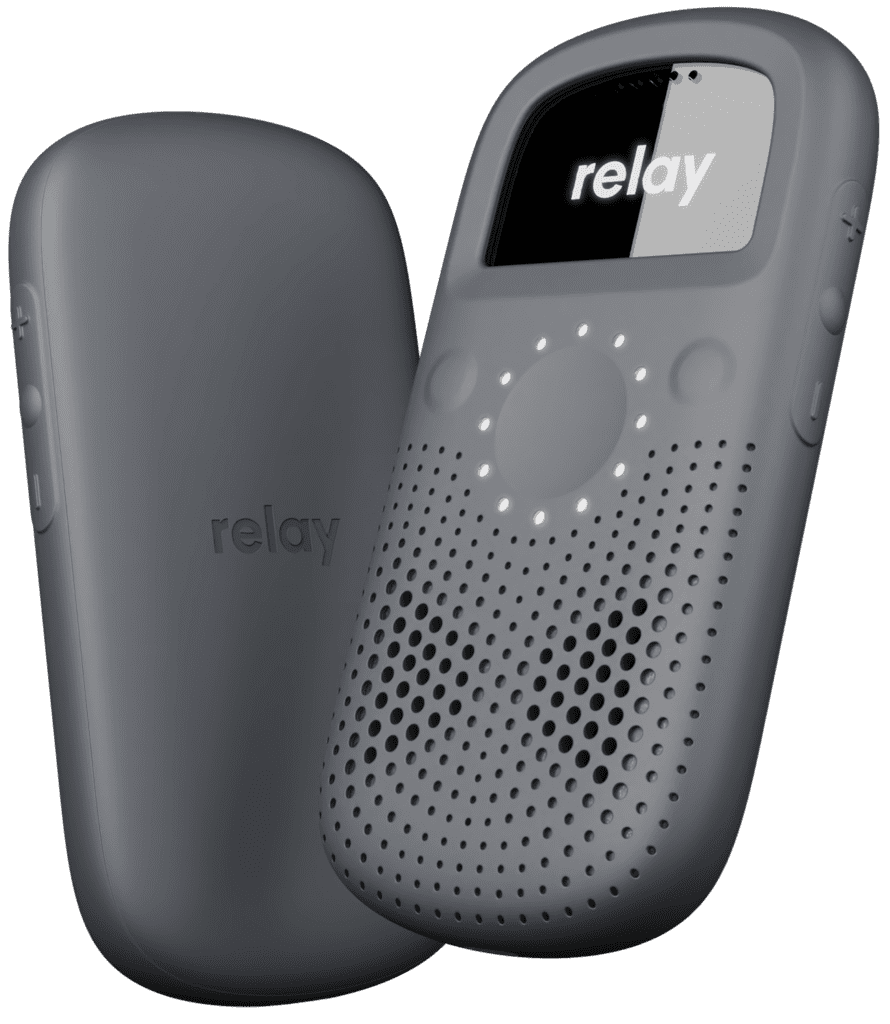
RelayX — built for the automotive floor.
The problem on the floor isn’t the screen; it’s breaking your work pattern to tap, type, or walk to a terminal. Relay is voice-first and purpose-built, so information moves in whatever fits the moment, whether that’s voice, a photo, the app, or desktop, without anyone breaking stride.
Steady Link™
Multi-patented dual-SIM 4G/5G redundancy; the message routes around outages and holds through thick walls and high interference.
TeamTranslate™
Real-time speech-to-speech translation across 35 languages, on the device.
Alert API
Connects fault events from SCADA, MES, FMS, PLC, and HMI and routes them to the right responder, repeating until acknowledged.
IP68 + IP69K durability
Military-grade tested and built for the harshest OEM and Tier 1 environments.
Frequently Asked Questions
A durable, voice-first device and cloud service that takes the place of your two-way radios and adds one thing radios never had: the ability to send a machine’s fault straight to the one person who can fix it. Relay is the system of action for physical operations: it captures what your frontline actually says and does, and turns it into action in the systems you already run.
The recoverable window is the time between the fault notification and the line being restored. Picture a typical stoppage: the alarm surfaces instantly, but then someone has to notice, production calls out for “someone on maintenance,” whoever answers first responds, right person or not, and the tech arrives without context. Cut the noticing, the wrong-person dispatch, and the cold diagnosis, and you claw back most of the delay before a wrench ever turns.
No. Relay sits on top of what you run now. Your PLCs, line controllers, and floor dashboards keep spotting trouble; Relay carries that trouble to a real person and keeps a record of how it got handled. Nothing gets replaced except the radios.
The opposite. A work-order system is only as good as what someone remembers to type in later. Because Relay records the conversation as the fix happens, the detail is already there, ready to feed the record instead of asking a tired tech to reconstruct it.
No. One person speaks into the device in their language and the listener hears it in theirs, in the moment, across 35 languages. A new hire’s language stops being a reason not to put them on a complex line.
Small. A crew can be using it by the end of one shift, and there’s nothing new to learn since it behaves like the radio already on their belt. The usual move is to try it on your worst-performing line first.
DETECTION IS SOLVED
See what Relay can do on your floor.
Your downtime, your radio fleet, and your shift handoffs are all communication problems. Let us show you the minutes you can get back, starting with your highest-downtime line.