Last Updated on September 29, 2026

The luxury stays guests remember are rarely built by what they can see. It is built by how quickly the right information reaches the right person behind the scenes.
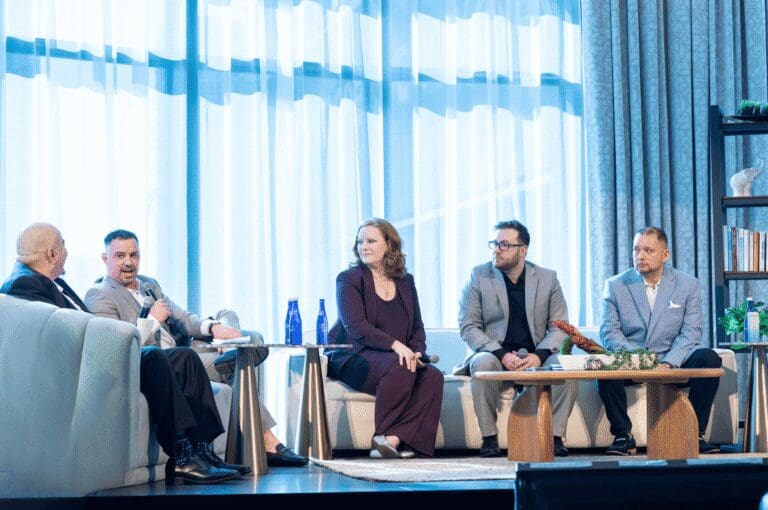
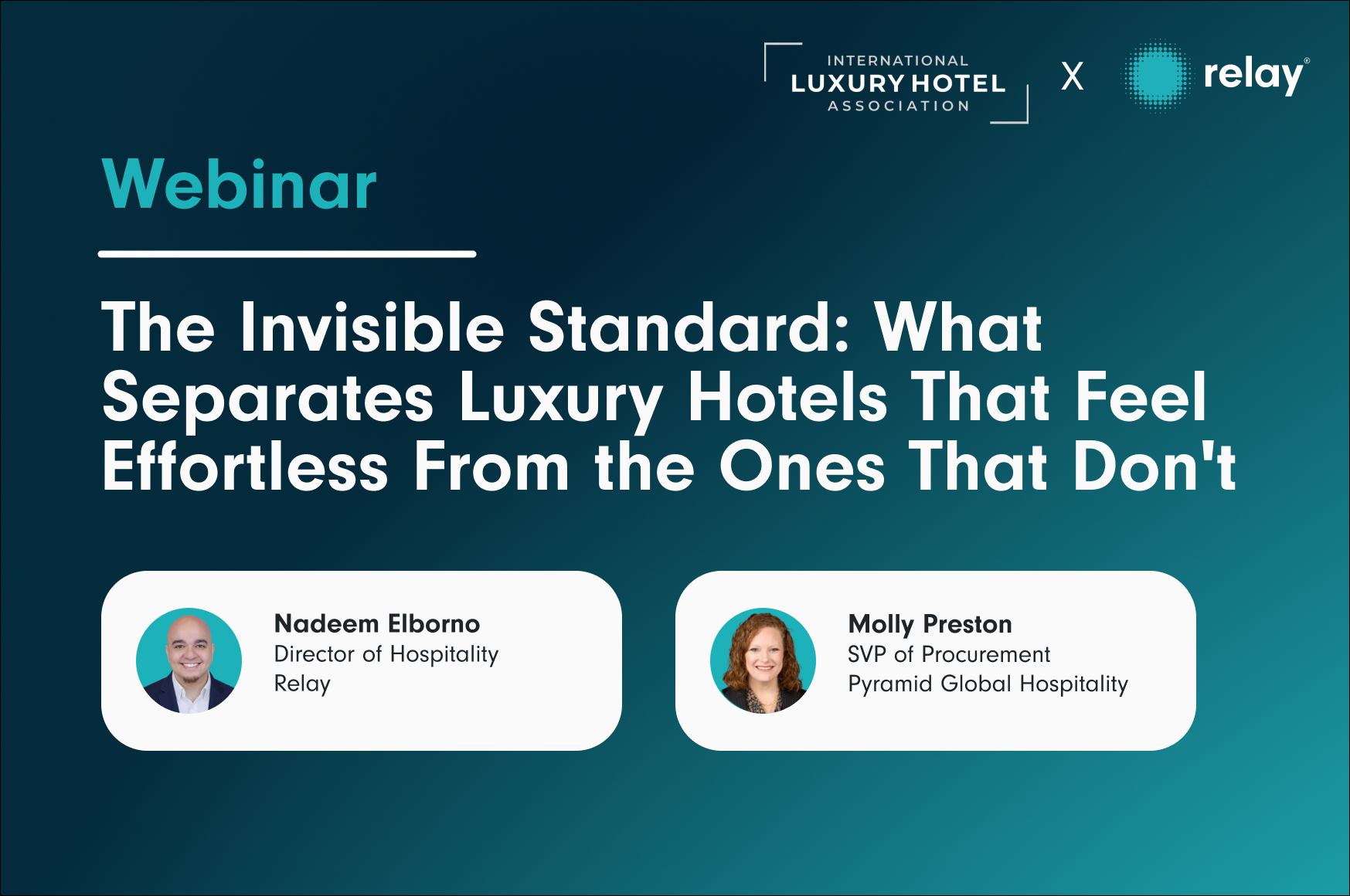
That idea sits at the center of a recent International Luxury Hotel Association webinar, where Nadeem Elborno, Director of Hospitality at Relay, joined Molly Preston, SVP of Procurement at Pyramid Global Hospitality, to explore what actually separates luxury properties that feel effortless from the ones that don’t.
The session covered a wide range of ground, from guest satisfaction data and communication volume benchmarks to a practical walkthrough framework operators can use this week. The through line was consistent: the hotel guest experience at the highest-performing properties is not the result of better amenities. It is the result of better operational coordination.
Why Staff Service Is the Strongest Revenue Lever
The panel opened with a data point that reframes how operators should think about investment. According to JD Power, staff service is the number one driver of guest satisfaction at luxury properties. Above the room. Above food and beverage. Above facilities.
Elborno shared that every point of improvement in guest satisfaction can move RevPAR by up to 1.42%. For a mid-size luxury property, that translates to roughly $300,000 in annual revenue. For larger resorts, the figure goes north of a million dollars. He cited McKinsey research reinforcing the point: luxury properties may see more return from investing in a culture of excellence — staff that can deliver extra touches and personalized experiences — than in marble floors and gold-plated fixtures.
The takeaway is clear. Investing in the people delivering the experience and the systems that support them is the highest-returning decision a luxury property can make.
Where Alignment Breaks Down
Preston described the most common source of friction across the Pyramid portfolio. “The most common place I see alignment break down is when information stops moving,” she explained. “One department knows something, another doesn’t. A guest preference gets captured but never shared. A VIP arrival is known by leadership but not by the frontline team. The intention is there. The communication isn’t.”
She compared hospitality staff communication infrastructure to plumbing. Nobody notices it when it works; everyone suffers when it doesn’t. When a housekeeper can’t receive updates in real time, when an engineer can’t be reached quickly, or when a valet request gets delayed because a message didn’t make it to the right department, the guest feels that friction immediately.
The data backs that up. JD Power reports that when a guest encounters a problem, satisfaction drops 217 points on a 1,000-point scale. Only 12% of those guests will report the issue. The other 88% simply don’t come back.
The Pace of Communication in Luxury
Elborno shared Relay research showing that luxury properties communicate at a fundamentally higher pace than standard hospitality operations. Luxury hotels are three times more likely to communicate across departments, while ultra-luxury hotels send 54% more messages on average. Large properties average roughly 15,000 messages per week.
That volume is not accidental. It is the operational footprint of properties that anticipate needs, resolve issues before guests notice them, and deliver consistency across every shift. The 15,000 messages represent room status updates reaching the front desk before a guest asks, maintenance requests acknowledged in seconds, and VIP preferences shared across departments before arrival.
Elborno pointed out that this communication volume is not just a metric. At the best properties, staying connected across departments is part of how teams operate. That pace is built into the culture deliberately.
Personalization Requires Information in Motion
A significant portion of the conversation focused on what it actually takes to personalize a luxury stay. Elborno shared that 75% of hospitality properties name personalization as their top priority, and PwC research shows luxury guests will pay up to 14% more for a highly personalized experience.
But personalization at scale requires more than guest profiles and CRM data. The data about a guest probably already exists. The real question is whether the right person on your team has that information at the right moment, naturally, not through heroic effort.
Preston reinforced this from the operator’s perspective. She described how truly aligned properties make the guest feel like they have one relationship with the hotel rather than a series of disconnected departmental handoffs. “The front desk knows what housekeeping knows. Housekeeping knows what guest services knows. Guest services knows what food and beverage knows.” When that alignment exists, guests experience personalization. What actually happened behind the scenes was communication, information sharing, and preparation.
Systems Create the Space for People to Shine
One of the strongest themes in the conversation was the relationship between systems and culture. Preston put it simply: when teams have the right tools, the right information, and the right support, they have the capacity to focus on the guest. Operational excellence does not replace hospitality. It creates the space for it.
She shared how the highest-performing properties in the Pyramid portfolio all have something in common. Their employees know they matter. And when employees feel valued and equipped, they create that same feeling for guests. “If we want employees to create memorable experiences for guests,” Preston said, “we have to create meaningful experiences for our employees, too.”
Practical Takeaway: The Ease Audit
Preston introduced a practical framework for operators: a 15-minute property walkthrough that scores 10 key guest moments on a simple scale. Zero for friction, one for neutral, two for ease. The moments include arrival, the welcome interaction, room readiness, public spaces, service requests, and departure, among others.
The critical step is scoring each moment from both the guest’s perspective and the employee’s. A guest arrival may look smooth from the outside: valet greets them, bellman takes the luggage, check-in is quick. A GM might score it a two. But if the valet didn’t know the guest was arriving, if the front desk didn’t know they were a VIP, if housekeeping didn’t know the room was needed early, and the team had to make five phone calls and three radio calls to make it happen, the employee side scored a zero.
“Friction for employees eventually becomes friction for guests,” Preston noted. She encouraged every GM listening to walk their property next week, score it honestly, and get their department heads to do the same.
Final Thoughts
This webinar reinforces an idea that luxury operators are increasingly recognizing. The hotel guest experience is a communication outcome. The properties that feel effortless are the ones where staff can coordinate in seconds, information moves freely between departments, and employees spend their time serving guests rather than fighting the operation.
For operators evaluating where their next investment will make the biggest difference, the answer may not be visible to the guest at all. It may be the communication infrastructure that makes everything else possible.