Last Updated on October 14, 2026
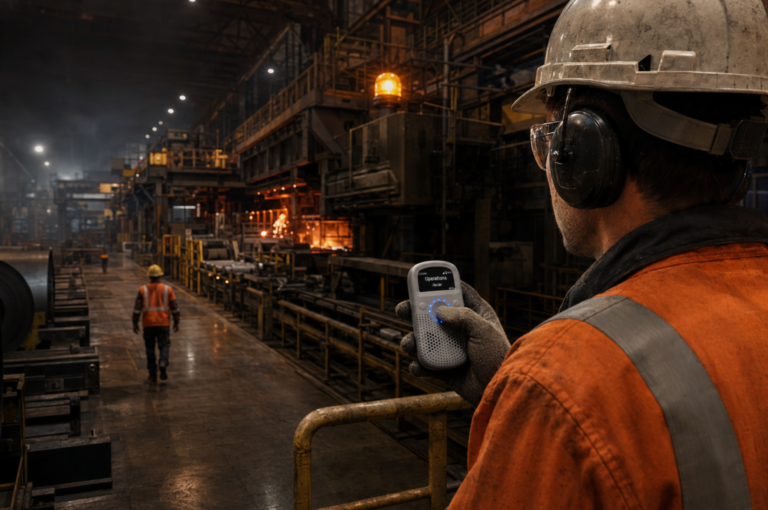
When we first started working with steel customers, an IT lead at one plant told us something our team still references today. They had tried mounting Wi-Fi access points (APs) near the melt shop, and the AP antennas melted. Molten steel, it turns out, is a tough neighbor for networking gear.
The story gets a laugh, but it points to a real problem. The places where frontline teams most need to reach each other are often the places where wireless works worst. That’s why Relay doesn’t depend on any single network. Our devices already move between Wi-Fi and public cellular on their own. Today we’re announcing a partnership with Celona that makes private 5G an easier option for the sites where those networks fall short. Relay devices are now certified on Celona Orion, Celona’s converged wireless platform that brings private 5G and Wi-Fi together on a network the enterprise controls. For teams on Relay, that means more consistent coverage across more of the site, including outdoor yards and the spaces between buildings.
Watch the highlights
In this short clip, Puneet Shetty, SVP of Product and Field Engineering at Celona, and I talk about what makes industrial sites so hard to cover and what the partnership means for teams on the floor.
Watch the full video here.
Why industrial sites are so hard to cover
Relay’s industrial customers run plants, mills, warehouses, and distribution centers. Many of those sites sit outside cities, on large plots of land where public cellular coverage was thin to begin with. Add metal buildings that block radio signals, campuses that stretch across acres, high heat, and constant movement between indoor and outdoor spaces, and coverage gets patchy fast.
Transitions are often where things break. A forklift driver rolling from a warehouse into the yard can pass from one Wi-Fi access point to the next, and then off Wi-Fi entirely. Each switch is a chance for a message to drop.
The usual fix has been to keep adding access points, indoors and out, until the gaps close. That gets expensive quickly, and some sites have received quotes in the millions of dollars to cover a relatively small area.
Public cellular brings a different problem: you don’t control it. A network that performs well today can change tomorrow when the carrier shifts capacity toward the highway next to your plant, or when a crowd gathers nearby. Nothing changed at your site, but your connection did.
Why reliability comes first
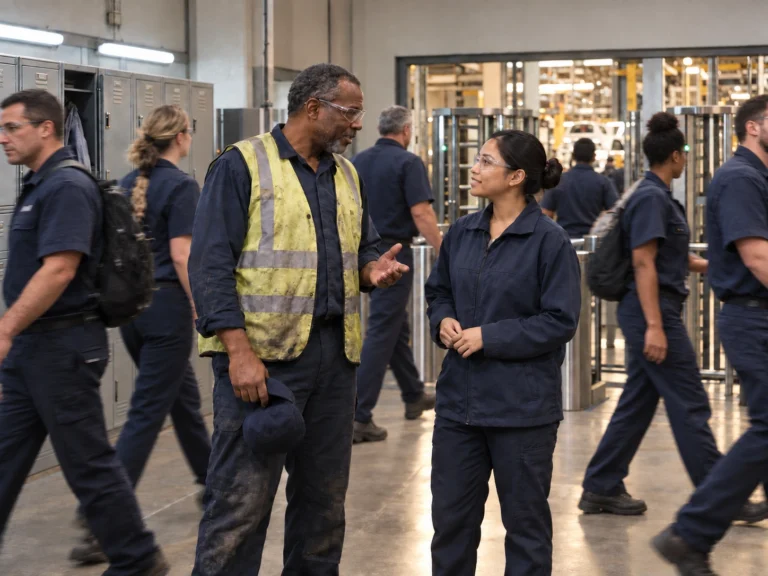
Push-to-talk earns its place on the frontline because people are on the move. If a worker were sitting still, a tablet or a computer would do. Relay is built for the operator walking between production lines, the driver on a forklift, and the maintenance tech crossing from a trailer into the plant.
In those moments, reliability is the whole point. If a message fails to get through while a crew is coordinating around a hazard or a line stop, people stop trusting the system and go back to shouting, walking over, or waiting. A connected worker program can only go as far as its coverage does.
A decade of building for hard connectivity
Relay has deep roots in the cellular space and has evolved our connectivity approach from a single-carrier SIM to multi-profile SIMs and now to a Dual SIM Dual Standby device with our latest hardware. Today, Steady Link™ moves Relay devices between Wi-Fi and multiple 4G and 5G networks on their own, and the hardware already supports private 4G and 5G networks. Working with Celona builds on that foundation: on a Relay device, Celona Orion is set up as a first-class network. A customer inserts the SIM, turns on the setting, and the device joins the private network.
What private 5G adds
Private 5G was built for movement. It’s designed to keep a device connected as it travels across a large site, it delivers consistent performance for critical traffic like voice, and it runs on a network the enterprise owns instead of one it shares with the public. Those three qualities (mobility, reliability, and control) are exactly what push-to-talk needs in a yard, on a dock, or across a sprawling plant floor.
As Puneet shared with me, for operations who are in environments where there’s a problem with connectivity, the private 5G network can come in and plug the gap.”
Coverage for the people, and for the record
More consistent coverage helps keep people reachable, and that matters most for safety. Panic alerts and location context depend on a device that can get a message out from wherever a worker happens to be standing.
It also matters for everything Relay does after a message is sent. Relay is the System of Action for Physical Operations: it captures what your frontline actually says and does, and turns it into action in the systems you already run. Teams keep talking the way they always have. Relay logs those calls, transcribes them, and translates them across 35 languages with TeamTranslate™, so the observations, handoffs, and judgment calls from each shift serve back to supervisors and the next crew as summaries and shift reports. Nobody has to type up notes at a terminal after a 12-hour shift.
Wherever a message drops, the record has a gap. Better coverage means your workers can always be in touch and results in a more complete record.
What this means for your site
If your site already runs Celona, Relay gives that network a push-to-talk system your frontline will use from day one. If you already run or are considering Relay, Celona offers a path to dependable coverage in the parts of your site where Wi-Fi and public cellular can’t extend. And if you’re planning a Wi-Fi refresh or weighing private wireless, it makes sense to look at both together.
Relay and Celona are already working side by side at manufacturing sites today. To talk through the toughest coverage areas at your site, contact our team.