Executive Summary: Consumer devices like Apple’s new AirPods Max 2 are making live translation mainstream, but industrial environments require more than conversational language tools. On the factory floor, communication often includes shorthand, slang, and tribal knowledge in the workplace that standard translation systems struggle to interpret. As the aging workforce in manufacturing retires and teams become more multilingual, organizations need communication tools designed specifically for frontline operations.
Apple’s announcement of the new AirPods Max 2 with built-in live translation is another sign that real-time language technology is going mainstream. But are these tools built for the factory floor?
Devices like AirPods Pro, AirPods Max 2, and other translation earbuds are bringing instant language conversion and multilingual communication to consumer conversations. The ability to speak one language and hear another in real time is an incredible feat—quickly moving from novelty to expectation.
But in industries like manufacturing, logistics, and food production, translation alone doesn’t solve a bigger challenge: knowledge transfer.
Experienced workers are approaching retirement, taking decades of operational expertise with them. Roughly 26% of U.S. manufacturing workers are now 55 or older, highlighting an aging workforce and placing millions of skilled employees near retirement.
At the same time, frontline teams are becoming increasingly multilingual. Preserving operational knowledge now requires more than translating words. It requires ensuring that experience, context, and intent move clearly between workers, teams, and shifts.
As live translation technologies become more visible in consumer devices, it raises a larger question for industrial organizations: what happens when communication isn’t casual and the stakes are operational?
Why Is Tribal Knowledge in the Workplace a Growing Challenge?
Manufacturing has always relied heavily on experience.
Many facilities depend on workers who have spent years learning the nuances of machines, processes, and production environments. Much of that expertise exists outside manuals or documentation and instead lives in everyday conversations between experienced operators and newer employees.
This type of expertise is often referred to as tribal knowledge in the workplace; the informal understanding workers develop over time that includes slang, machine nicknames, shorthand instructions, and process-specific terminology unique to a particular facility.
A veteran worker might explain how a machine “sounds different” before a failure or demonstrate a shortcut that reduces maintenance downtime. These insights rarely appear in written procedures, yet they are essential to keeping operations running smoothly.
For decades, this knowledge transfer happened naturally on the shop floor, but today’s workforce dynamics are changing that equation. As experienced employees retire and younger workers enter the industry, manufacturers are discovering how much operational knowledge lives outside documentation.
At the same time, many organizations face a growing language barrier in the workplace as teams become more multilingual. Effective multilingual workforce communication strategies are becoming essential to ensure operational context and meaning are communicated clearly across languages.
This is where communication technology capable of capturing and translating frontline knowledge becomes incredibly important.
Do AirPods Live Translation Tools Work on the Factory Floor?
Most discussions about voice AI focus on convenience, but industrial environments reveal the real difference between consumer vs. enterprise translation tools.
If a voice assistant misinterprets a song request or mistranslates a casual conversation, the consequences are minor. Users simply repeat the request.
Industrial environments operate under a very different tolerance for error.
If a worker asks for a maintenance procedure and receives instructions for the wrong machine, the result isn’t just an inconvenience. It can lead to downtime, production delays, or safety risks. For this reason, voice AI systems used in industrial environments must meet a much higher standard of reliability.
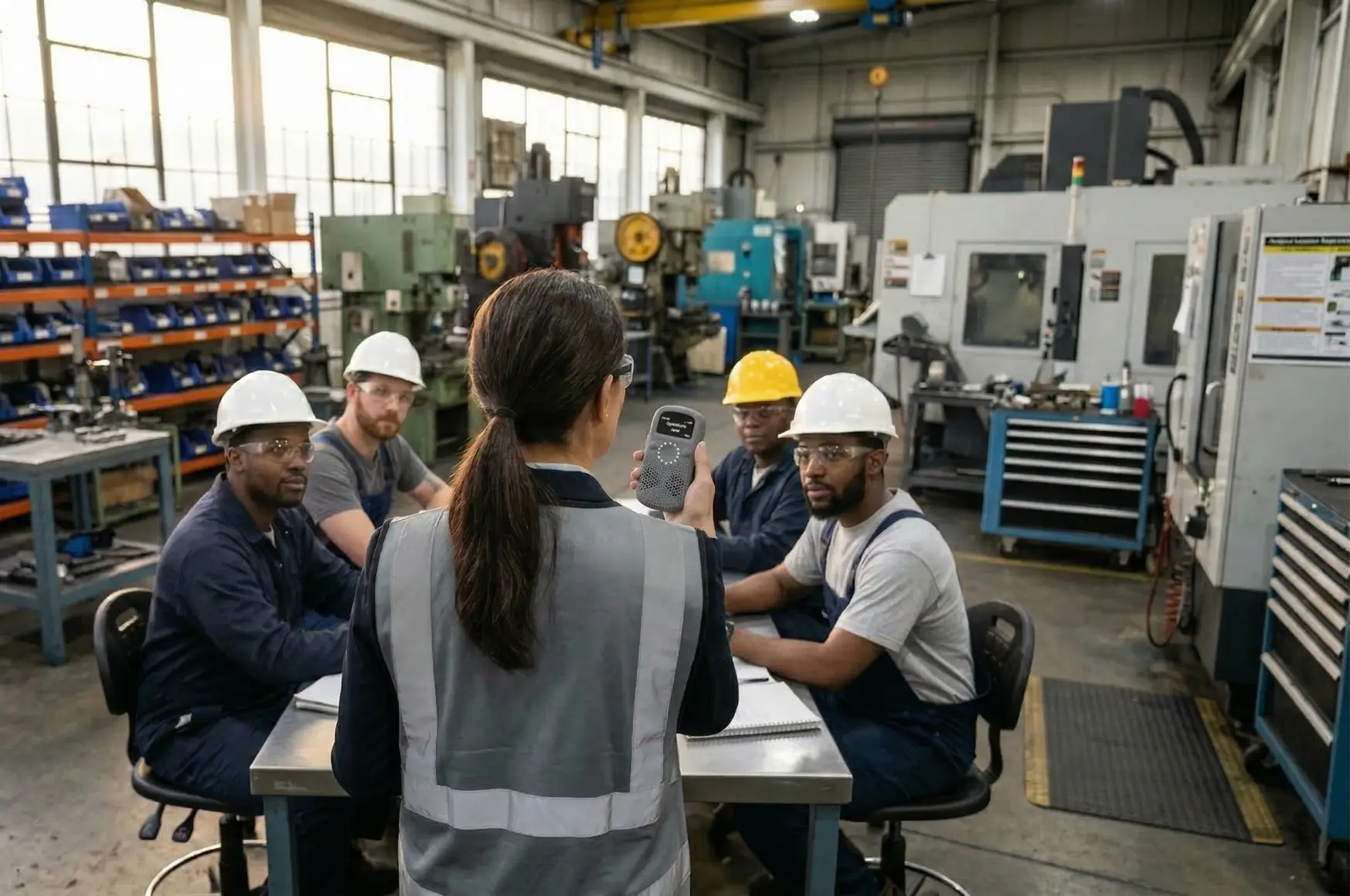
That reliability begins with accurate audio capture and speech transcription. Factory floors are noisy environments filled with machinery, movement, and workers wearing protective equipment. Capturing clear speech under these conditions is difficult but essential.
Translation can only be as accurate as the transcription that comes before it. Without high-quality audio and reliable transcription, even advanced live translation technologies may struggle to produce dependable results.
Live Translation Is Going Mainstream. Is Shop Floor Communication the Next Step?
The rise of real-time translation earbuds and other language translation technologies shows how quickly language tools are evolving. Consumer devices are making multilingual communication easier than ever, and Apple’s latest entry into the space will likely accelerate awareness and adoption.
But the environments where communication matters most, factories, warehouses, and production facilities, require solutions designed specifically for frontline work.
In these settings, translation isn’t simply about understanding another language. It’s about ensuring operational knowledge moves clearly between workers, across teams, and between generations of the manufacturing workforce.
As industries navigate labor shortages, multilingual teams, and the retirement of experienced workers, communication technology will play a central role in preserving institutional knowledge.
The future of AI on the factory floor isn’t just about smarter technology. It’s about building translation solutions for frontline workers that actually work where the work happens.
Authored by Ibraheem Khalifa, Vice President of Solutions, Relay