Last Updated on September 2, 2026
Wearable translators are compact tools that are quickly gaining traction in fast-paced industries, such as hospitality, warehousing, and security, among others. A wearable translator is a portable, hands-free device that provides real-time language translation, enabling seamless communication between people who speak different languages.
In high-pressure, fast-moving, and multilingual work environments, delays or misunderstandings caused by language barriers can impact safety, efficiency, and customer experience. That’s where wearable translator devices play a crucial role, providing seamless translation for multilingual teams as a powerful tool for real-time communication.
At a Glance
- A wearable translator device is a hands-free, purpose-built tool that delivers real-time language translation without requiring staff to stop, reach for a phone, or navigate an app. That hands-free advantage matters most in roles where workers are moving, operating equipment, or managing customers simultaneously.
- Real-time language translation on wearables works through three stages: audio capture, cloud-based AI processing, and translated output delivered to the listener in their preferred language. Connectivity quality is the most important variable in how fast and reliably that translation arrives.
- For multilingual teams, wearable translators reduce the most dangerous type of miscommunication: instructions that were heard but not understood. In warehousing, healthcare, and manufacturing, that distinction has direct safety implications.
- When evaluating a translation device for multilingual teams, language coverage and accuracy in noisy environments matter more than the total number of languages supported. Test in real working conditions before rolling out, not in a quiet demo room.
How Does a Hands-Free Translation Device Compare to Phone Apps?
When it comes to real-time communication, wearability can make a huge difference in communication flows and situation management. A wearable translator, with its hands-free design, enables workers to communicate instantly without needing to reach for a phone, launch an app, or navigate screens. This hands-free freedom translates to faster response times, fewer interruptions, and safer operations, especially in roles where multitasking is a constant requirement, providing a sense of ease and comfort.
By contrast, handheld translators and app-based solutions often require employees to pause their activities, which can be frustrating or even dangerous in time-sensitive situations. Many of the tools available on the market tend to rely exclusively on WiFi or the single cellular network their cell phone works off of, which can be unreliable in large buildings or remote sites.
That’s why wearable translation is especially beneficial for:
- Deskless teams: These may include housekeepers, maintenance workers, or security staff who are always on the move.
- Frontline roles: Roles such as nurses and warehouse workers, where they can’t afford delays caused by language gaps.
- Multi-lingual teams: Accessing instant translation for multilingual teams breaks down communication barriers and helps everyone stay on the same page.
What is a Wearable Translator Device?
At their core, wearable translator devices are designed to capture spoken language and instantly convert it into another language. Using a combination of real-time audio capture, AI-powered translation, and wireless connectivity, these devices enable seamless communication between individuals who don’t share a common language.
Most wearable translator devices feature:
- Multi-language support: Many support 20+ languages, covering the most commonly spoken languages in global workforces.
- Long battery life: To survive long shifts without constant recharging.
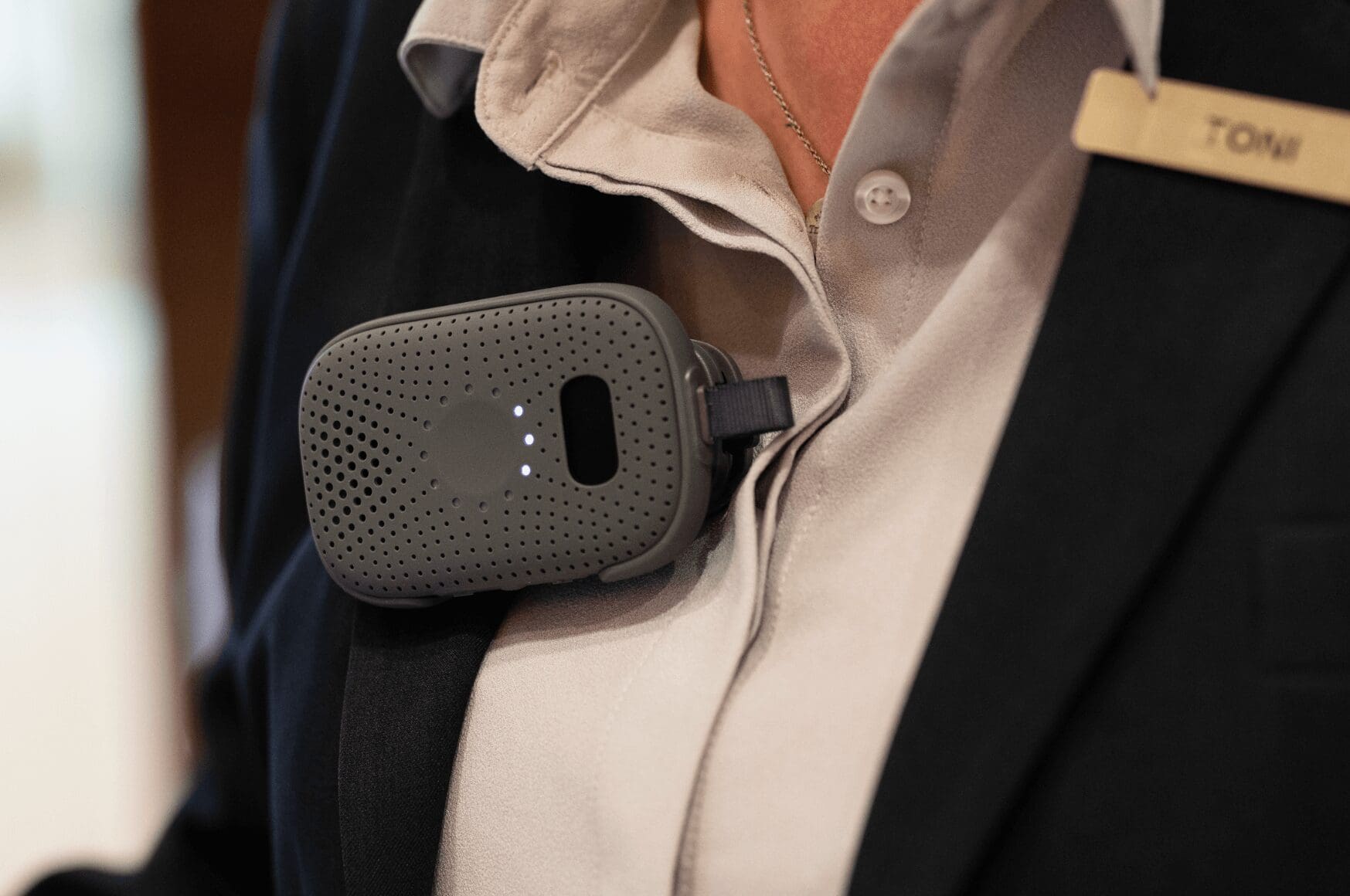
- Compact and portable form: Designed to be clipped onto uniforms, belts, or worn around the neck, thereby eliminating the need to pull out a phone or a device.
While general-purpose wearables, such as smartwatches with translation apps, offer occasional convenience, they aren’t necessarily suited for business use. They tend to lack the ruggedness, security, and instant responsiveness required in critical business environments.
How Does Real-Time Language Translation Work on Wearables?
The process happens in three stages, fast enough that the conversation barely pauses.
First, the device captures speech through a built-in microphone. On purpose-built wearables, these microphones are calibrated for the ambient noise conditions of industrial environments, such as background machinery, ventilation systems, and busy floor activity, rather than for quiet conversation.
Second, the audio goes to a cloud-based translation engine that processes natural language, identifies the source language, and generates translated output. AI-powered engines have improved significantly, and most now handle conversational speech in common languages with high accuracy.
Third, the translated output reaches the listener through a speaker on the wearable device, through connected earpieces, or as text on a paired screen. The time between the original message and the translated output is typically a matter of seconds on a reliable connection.
Connectivity quality matters more than most buyers expect. Systems that access both cellular and Wi-Fi networks simultaneously deliver more consistent performance in large facilities where network coverage can be patchy. Single-network solutions are more vulnerable to dead zones and latency spikes.
For multilingual teams, the practical advantage is simple: the listener hears the translation in their preferred language without any action on their part. The speaker talks normally. The device handles everything else.
Industries Using Wearable Translators
Wearable translator devices are transforming how industries with high-paced, multilingual workforces communicate.
Hospitality
Hotels are bustling hubs of multilingual interaction, from international guests at the front desk to diverse housekeeping teams. Relay empowers staff with hands-free, real-time communication and translation, ensuring seamless service across languages.
At Fairfield and TownePlace Suites in Norfolk, management credits Relay with boosting both response times and team confidence. As one manager put it:
“We love our Relays here. I would 10/10 choose these over a traditional radio any day of the week.” – Sara Dahlkoetter, General Manager at Fairfield and TownePlace Suites of Norfolk
Warehousing and Manufacturing
In warehouses and manufacturing plants, productivity and safety depend on clear communication across a multilingual workforce. Misunderstood instructions for heavy machinery or logistics can cause serious delays and accidents. Relay’s hands-free, wearable translator bridges the language gap in real time, ensuring every worker understands critical commands and safety protocols to keep operations running smoothly and securely.
Healthcare
Language should never be a barrier to patient care. For nurses and caregivers working with patients who don’t speak English, Relay’s wearable language translator device enables smoother check-ins, safer responses, and better emotional support tailored to a patient’s language.
Facilities and Fieldwork
From cleaning crews in large office parks to technicians on remote job sites, facility teams rely on precise, mobile coordination. Relay’s wearable, real-time translation radio communication device supports real-world work, which is often movement-heavy, hands-on, and frequently spread across large campuses or outdoor areas.
Security and Events
Security staff and event personnel operate in dynamic environments with zero tolerance for miscommunication. With wearable translator devices, they can issue instructions, coordinate responses, or report incidents in real time, even across language barriers. The built-in push-to-talk and GPS tools further streamline responses in crowded or high-risk areas.
Relay’s Translator + Safety Capabilities
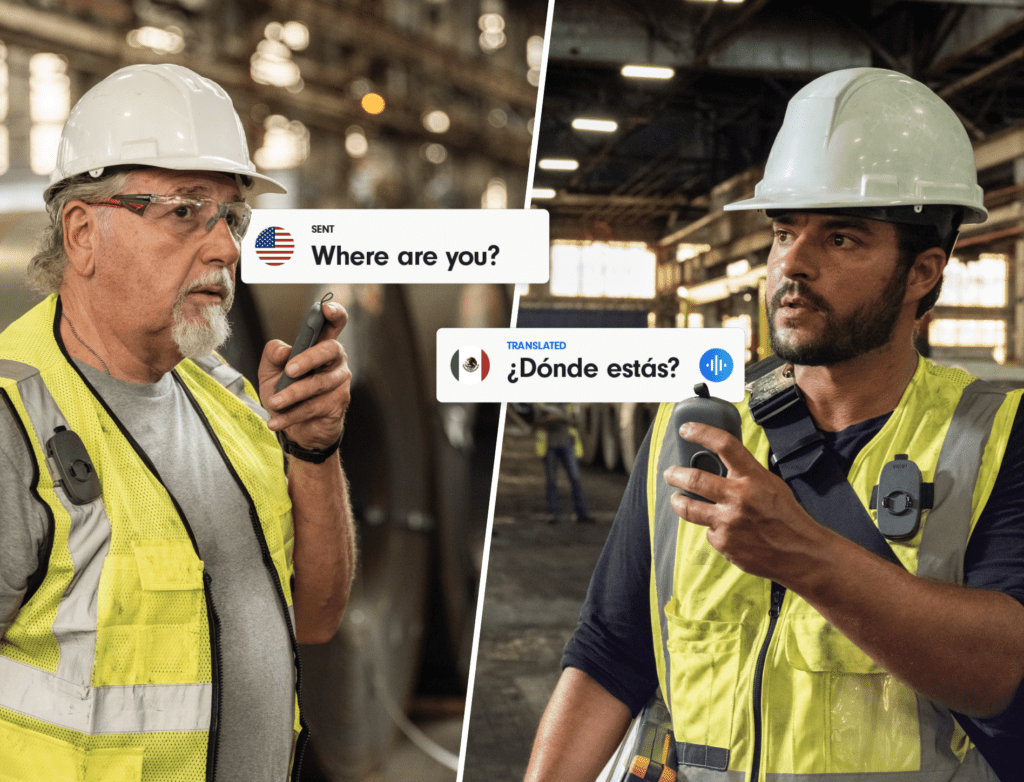
Relay’s wearable translator isn’t just a translation tool, it’s part of a broader real-time radio communication system.
That means workers can push-to-talk, send alerts, and receive translations all through one streamlined device. And because it’s cloud-powered and optimized for enterprise, there’s no clunky setup or app dependencies for employees to navigate, making it easier to adopt.
Relay’s wearable translator is designed for teams that need to move fast, stay connected, and feel protected, especially in industries where communication breakdowns or safety risks can’t be ignored.
At its core is TeamTranslate™, Relay’s enterprise-ready, AI-powered translation tool optimizing translation for multilingual teams. With support for 30+ languages and growing, it allows frontline and deskless teams to communicate naturally in their language, with translations delivered instantly to the listener in their preferred language.
Relay’s wearable translators also serve as a crucial tool for emergency communication. Workers can trigger an instant safety alert using a discreet, built-in panic button. Alerts are sent directly to designated responders, complete with the worker’s real-time GPS location and open push-to-talk communication.
Explore more of Relay’s Worker Safety capabilities here.
Translation Only vs. Full Communication System
While most wearable language translator devices on the market act as standalone tools, Relay’s TeamTranslate™ offers a comprehensive communication system. Relay devices are built for team coordination, featuring push-to-talk functionality, group channels, and multilingual support that keeps everyone informed across different languages.
Durability and Software Integration
Unlike many off-the-shelf translators that are delicate or designed for tourist-level use, Relay is industrial-grade, water-resistant, drop-tested, and ready for real-world frontline conditions. Additionally, it integrates seamlessly with team structures and requires minimal IT setup, ensuring a seamless and reliable user experience.
Passive Tools vs. Real-Time Alerts
Where other devices stop at passive listening, Relay keeps teams protected. If an incident occurs, a user can trigger the panic button, instantly broadcasting their location and a call for help to supervisors or emergency contacts.
In fast-moving environments where every second counts, Relay serves as a comprehensive solution that empowers teams to communicate across languages, respond to emergencies, and stay connected hands-free in real-time.
Interested in learning more about how Relay works? Book a demo to learn how Relay can transform the way your team communicates.
Frequently Asked Questions
What is a wearable translator device?
A wearable translator device is a small, portable gadget that provides real-time language translation, typically worn on a lanyard, clipped to a belt, or used as an earpiece. Unlike phone apps, wearable translators are hands-free and purpose-built for noisy work environments, making them practical for hotel staff, healthcare workers, manufacturing teams, and other frontline roles where language barriers affect daily work.
What is a translation device and how does it differ from phone apps?
A translation device is dedicated hardware that captures speech and provides translation output, usually through a speaker, screen, or earpiece. Compared to phone apps, dedicated devices are faster (no app-switching), more reliable in noisy environments, don’t drain your phone battery, and work hands-free. Phone apps work for occasional use, but dedicated devices are designed for workers who need translation constantly.
How does real-time language translation work on wearables?
A wearable translator uses a microphone to capture speech, sends it to a translation engine (usually cloud-based), and delivers the translated output within a second or two. Some devices translate to audio, others to text on a small screen. Accuracy depends on the languages involved, background noise, and the quality of the translation engine. Most modern wearables support 20+ common languages.
Pros and cons: hands-free translation device vs phone apps?
Hands-free devices win on speed, reliability, durability, and usability during active work. Phone apps win on cost, flexibility, and the fact that employees already have phones. Devices are the right choice for frontline workers who need translation constantly or work in environments where phones are impractical. Apps are fine for office staff or occasional translation needs.
What should you evaluate when choosing a translation device for multilingual teams?
Evaluate which specific languages your team needs (not just the total supported), accuracy in your actual work environment including background noise, ease of use during active work (can staff activate it quickly and hands-free), device durability for your conditions, battery life across full shifts, and total cost including service plans. Test with actual employees in real conditions before rolling out.