A work instruction tells a new hire how a machine is supposed to run. However, it does not mention that the machine tends to jam after certain changeovers, or what the second-shift operator does to stay ahead of it. By the end of each shift, that adjustment has already become a habit, and a habit is hard to write down. This is how know-how slips away from a plant, and the loss often shows up only after that operator retires and the jams start again.
For plant leaders, industrial wearables offer a way to hold on to that knowledge. These are rugged devices worn on a shirt or vest that let workers reach their team with the press of a button, instead of stopping to type into a phone or tablet. When an experienced operator explains a fix over one of these devices, the conversation can be transcribed and logged, so the explanation stays with your company even after that operator retires. That can mean fewer repeat problems when a veteran leaves and a faster path for new hires to learn what that veteran knew.
This piece draws on Relay’s survey of 500 manufacturing professionals. To read our full research, see The Factory Floor’s Missing Data Layer.
At a Glance
- Industrial wearables let experienced workers share what they know without stopping the job. Hands-free, voice-first devices fit the loud, gloved, full-handed settings where much of a plant’s expertise is shared.
- Knowledge transfer from experienced workers is manufacturers’ top five-year challenge. In Relay’s August 2026 survey of 500 full-time manufacturing professionals, 44% ranked it first, ahead of AI and automation adoption.
- The knowledge most at risk is how experienced workers handle problems. Equipment troubleshooting leads the list, and few plants have a formal way to capture it.
- Knowledge retention can happen inside the work itself. Expertise no longer has to depend on someone finding time to write it down afterward.
What Are Industrial Wearables, and How Do They Fit a Manufacturing Plant?
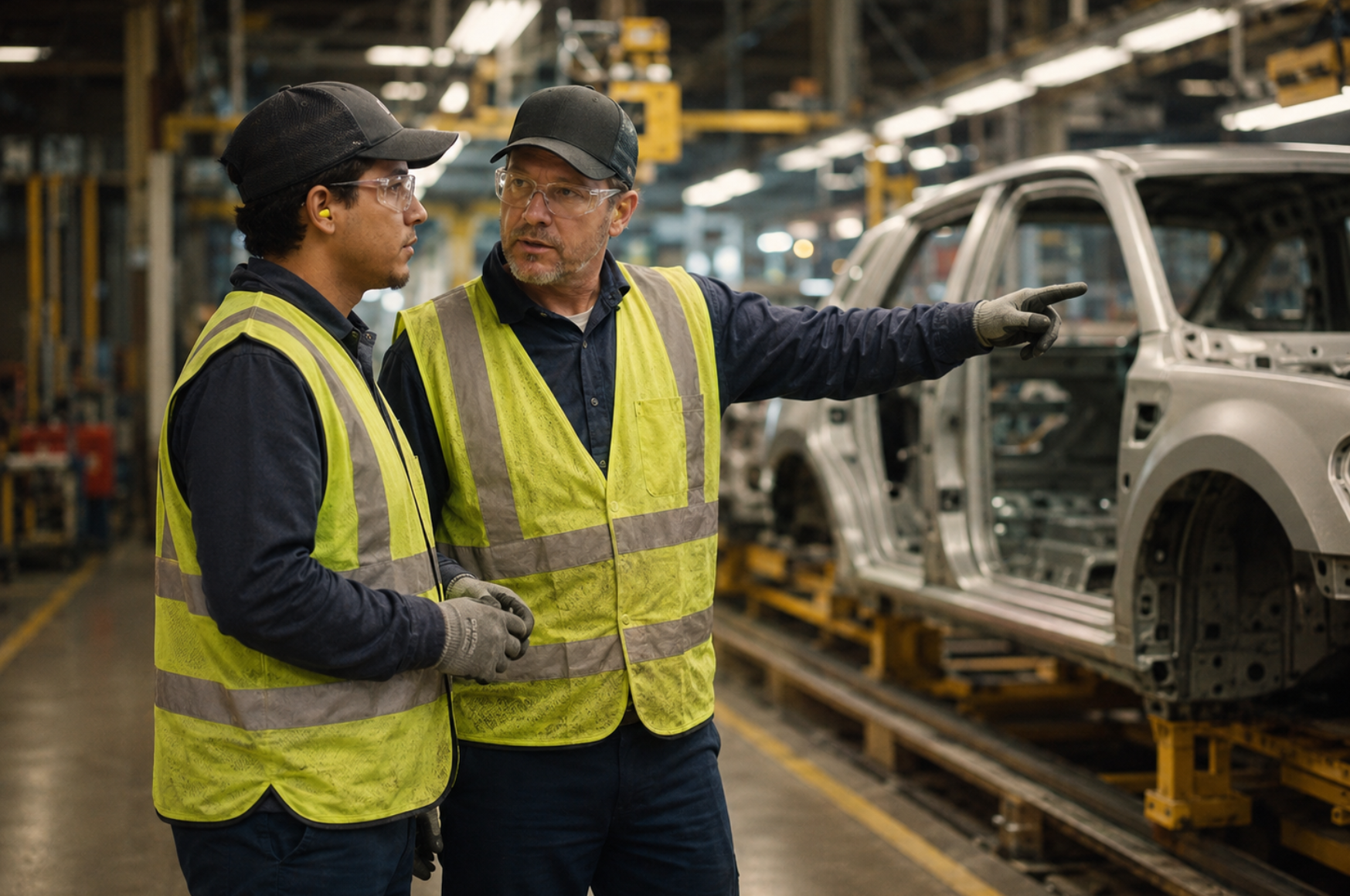
Industrial wearables are rugged, body-worn devices built for plants and facilities where gloves, noise, and full hands make phones and tablets impractical. They are designed to keep working in loud, wet, or cold areas, and the devices are voice-first, so workers can reach one another with a button press, without walking away from the job. That puts them on the plant floor, where experienced workers solve problems and explain their decisions out loud as they happen, and where what they know can disappear once the conversation ends.
What Institutional Knowledge Is Lost When Experienced Workers Retire?
When experienced workers leave, the institutional knowledge most at risk is how they handle a machine when something goes wrong. According to Relay’s survey, respondents named equipment troubleshooting as the knowledge most at risk (34%), followed by undocumented workarounds and informal processes (16%). Yet only 23% of organizations document departing workers’ knowledge through a formal documentation program, and 17% have no formal process at all. That leaves much of what they know in their heads and in everyday conversations, and the handoff between shifts is where it can slip.
Why Does Knowledge Transfer Break Down Between Shifts?
Institutional knowledge moves between shifts and systems mostly through people, and mostly by hand. In Relay’s survey, 82% of organizations rely on employees to manually relay information between teams, systems, or shifts, and 56% say recording a single issue with their current tools takes four minutes or more. On the floor, that friction looks familiar:
- Handoff notes get rushed. They are often written in the last few minutes of a shift, when the day’s details are already fading.
- Radio calls reach only the people listening. Anyone who missed the call, including the next shift, may never hear what was said.
- Forms often leave out the “why.” A dropdown records the category of an issue but rarely the reasoning behind the fix.
- Translation can lose detail. When an explanation has to be relayed in another language on the spot, small details can slip.
Each is a small loss, but they compound: 41% of respondents say communication breakdowns or undocumented issues contribute to delays, rework, missed handoffs, or production disruptions at least once a week.
Are Manufacturers Ready for Experienced Workers to Retire?
How ready manufacturers feel for experienced workers to retire depends on who you ask. Across the full survey, 75% are concerned about losing institutional knowledge and 64% feel prepared for it, but the answers split by role:
- Readiness for retirements: 85% of executives feel ready, compared with 57% of frontline workers.
- Access for new hires: 89% of executives are confident new workers can quickly find the knowledge they need, versus 62% of frontline workers.
A retention plan holds up better when it is tested against the floor’s view as well as the front office’s, which starts with how knowledge is actually shared rather than how it is supposed to be.
How Do Industrial Wearables Support Knowledge Retention?
Industrial wearables support knowledge retention by logging the voice exchanges, which is where critical information already moves. When a worker explains a fix over push to talk, the exchanges are transcribed and timestamped, and made searchable, like with Relay’s dashboard. What an experienced operator says today can still be found by the next shift, or the next hire, long after the conversation ends.
Because Relay logs what workers already say over push to talk, there’s no separate documentation step: no form, no tablet, and no trip off the line. Our guide to overcoming resistance to change covers how to bring teams along when you introduce new technology.
How Can Plant Leaders Start Preserving Institutional Knowledge?
Plant leaders can start preserving institutional knowledge with one handoff where the team already improvises. According to Relay’s survey, 38% of respondents say their teams improvise often or very often because information from a previous shift or log is missing. Shift change is a good place to start: ask experienced workers to explain the reasoning behind their calls as they make them, and then use those transcripts to train newer teammates.
To read our full research on knowledge transfer, including how executive and frontline views differ, see The Factory Floor’s Missing Data Layer.

Frequently Asked Questions
What are industrial wearables used for in manufacturing?
In manufacturing, industrial wearables are used for push-to-talk voice contact with a team, emergency alerts, and location alerts, and some also log and transcribe voice conversations so they can be found later. With Relay, a worker can send a panic alert with the press of a button or a spoken phrase, and the alert shares the worker’s location, indoors or out, so the right people know who needs help and where to go.
Do industrial wearables replace sensors and machine data?
No, they complement them. In Relay’s survey, 86% said sensor and machine data alone are not enough to understand the shop floor, and 85% named frontline worker observation, alone or combined with machine data, as the source of the most valuable insights, compared with 12% who named machine data alone. The strongest picture comes from using both.
Do industrial wearables work for multilingual teams?
Yes. Relay’s TeamTranslate translates speech in real time across 35 languages, so workers who speak different languages can talk on the same push-to-talk channels they already use. It’s trained on industrial language, so it’s built for the short, fast way people talk on the floor. Our wearable translator guide covers how to evaluate translation devices.
What should manufacturers look for when choosing industrial wearables?
Look for military-grade durability, audio that carries over machinery noise, a battery that lasts through a double shift, and coverage that doesn’t require repeaters or other equipment you have to install and maintain. RelayX is IP68/IP69K rated and MIL-STD-810H tested, with noise cancellation built for environments up to 110 dB and up to 24 hours of battery life. It connects over multiple cellular carriers and Wi-Fi, so it needs no repeaters or FCC licenses.