By: Jim Mulcahy, President and Co-founder
I first heard this problem in 2018, in a ballpark of all places. An operations manager told me, “I’ve doubled the size of my staff, performance hasn’t changed, and I have no idea why.” We have been chasing the answer to that sentence ever since.
At a conference I recently attended, a customer of ours told two stories just before I spoke. In the first, an operator said out loud, on the radio, every shift for three weeks, that a pump was running rough. None of it ever reached a system. In the second, a potentially useful alert went off, but it landed in an inbox no one was monitoring. The system knew, but the action lagged.
Those look like two failures, one about what is said and one about what is known, but to me, they expose a singular problem: there’s a gap between a system that knows something and a person who can do something about it. I think of it this way: your plant runs twice: once in the systems and once on the floor. Neither of these alone delivers the right record, but together, they are meaningful.
The Data Gap
Today, Relay is releasing research that puts numbers behind the impact this gap has on businesses. With Dynata, we surveyed 500 full-time U.S. manufacturing professionals. It is perception research, so it reflects what people say about their own operations.
The number that felt most impactful to me – though not surprising: Fifty-seven percent most commonly cited verbal communication as the channel for critical operational information. Eighty-six percent say sensors and machine data alone are insufficient to understand the shop floor. Only 20% say their formal systems reflect a typical shift very accurately.
Investing in machines first was the right call because machine data is measurable and repeatable. It is only part of the picture, though, and the operator’s context is what goes missing.
Two Plants, One Company
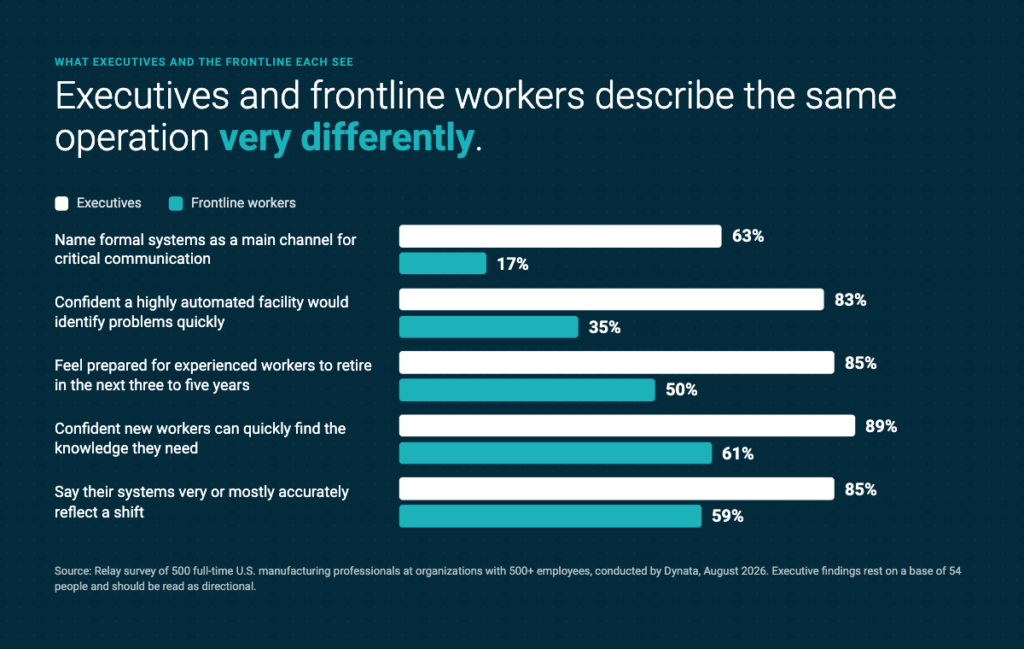
We also asked how confident people are that a highly automated plant could spot problems on its own. Eighty-three percent of executives said they were, compared with 35% of frontline respondents, a 48-point gap.
I do not read that as leaders being out of touch, since the plant data and models are well-built. One group sees the plant as it is recorded, and the other sees it as it runs. If you decide from half the story, you can fund the wrong fixes, find root causes late, and pay for the same failure twice.
The Action Gap
Even when a system does know something, that knowledge may fail to reach the person who can act. Eighty-two percent of respondents rely on employees to carry information between teams, systems, or shifts by hand, and 56% say documenting one issue takes four minutes or more, meaning they may not bother if they can implement a fix just as quickly.
In our experience, two things keep this gap open. Alerts land in inboxes and on screens that are hard to watch in an eyes-up, hands-busy job, and when too many alerts fire, people can stop paying attention. This isn’t just a manufacturing problem. Logistics providers, hospitals, and hotels have all learned that when people get more alerts than they can act on, they stop acting on them. The usual fix is better analytics, which helps. But sending an alert to the right person also depends on who is nearby, who is free, who is already on it, and what the last shift said. No machine knows that. It’s carried by the operators working the floor.
The model is the andon cord, made smarter. A pull on an andon system reaches that station’s team leader, not the whole plant. Keep that targeting and base it on live information: the right person, the right team, and an escalation that moves up when nobody answers, rather than waiting out a timer. Connect every sensor to every radio without that targeting, and the alarm flood moves into everyone’s earpiece.
That is why I see the two gaps as one problem. Good routing runs on the same floor knowledge most plants are not logging today.
What it Takes
I am an engineer by training, so let me be candid about what is hard when finding the right fix. The solution has to beat the radio at the radio’s own job: hands-free, heard at 110 decibels, built for the floor, lasting the shift, and carried by everyone. Then it has to do what a radio cannot: reach the right person, remember what was said, and retain it for future workflows.
The intelligence is harder. Nobody buys vibration readings, and nobody should buy transcripts. Searching is not knowing. The value is the pattern: nine mentions, four operators, two shifts, and a work order opened with the reasoning attached. To get there, a system has to understand real plant audio, connect scattered remarks, give the same answer at 2 p.m. and 2 a.m., and show its reasoning. And because anything that needs new behavior gets rationed, adoption decides how much of the floor you actually log. If people already wear it, you log the whole shift.
Relay is the System of Action for Physical Operations: it captures what your frontline actually says and does, and turns it into action in the systems you already run.
What Changes
Replay the two stories. The alert reaches the right technician by voice, escalates if nobody answers, and closes with what the technician found. What the operator says is captured the first time they say it, the pattern shows up, and a work order opens with his reasoning attached. A throughput dip arrives with its cause attached. A veteran’s know-how stays after they retire, which matters when 44% rank knowledge transfer as their top five-year challenge.
Talk that is never logged can be gone for good. For twenty years, the machines have been talking. The people running them have been talking, too, and explaining why. Now you can hear both and act in time.
Read the Research
There’s a lot more to read and share with your colleagues in the full report. It comes in two editions. If you run multiple sites, start with “The Factory Floor’s Missing Data Layer.” If you run a plant, start with “Why Your Downtime Report and Your Floor Disagree.” I’d love to hear what you think and how you’ve implemented any of these suggestions in your own operation; feel free to drop me a note on LinkedIn.