Shift handovers in manufacturing are one of the most significant yet undertracked sources of extended downtime, repeated failures, and operational knowledge loss on the plant floor. In high-throughput environments where downtime costs thousands of dollars per minute, the gap between what a machine reports and what a team communicates during a shift change can determine whether an issue takes 30 minutes to resolve or three hours.
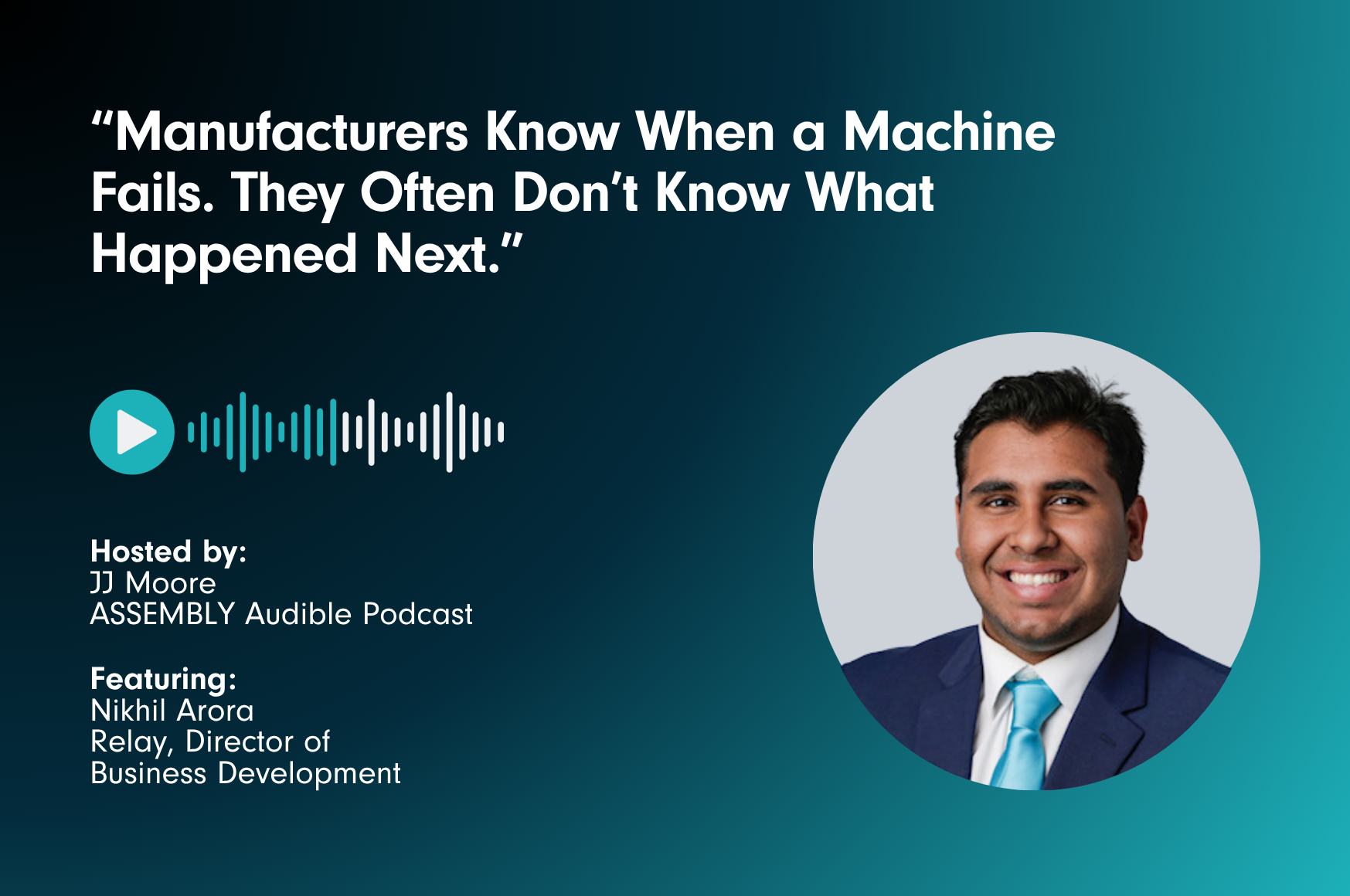
That challenge was the focus of a recent episode of ASSEMBLY Audible, where Nikhil Arora, Director of Business Development at Relay, joined host JJ Moore to examine why shift handoffs have become a growing blind spot in modern manufacturing. The conversation explored the disconnect between Industry 4.0 machine data and Industry 5.0 human coordination, the real cost of coordination breakdowns, and how manufacturers are starting to capture frontline knowledge more effectively.
At a Glance
- Shift handovers are a major source of hidden manufacturing downtime. Coordination breakdowns during shift changes can extend downtime well beyond the original equipment failure, adding thousands of dollars per minute in costs that rarely show up in OEE dashboards.
- Industry 4.0 solved machine visibility but not human coordination. Manufacturers know when a machine goes down and when it comes back online. What they often miss is who responded, what was communicated, and what unresolved risks remain.
- Shift report creation is consuming 45 to 60 minutes of operator time per shift. That time is spent manually reconstructing events from memory, which creates quality and completeness gaps in the information passed to the next crew.
- Tribal knowledge in manufacturing is retiring faster than it is being captured. As experienced operators leave, the informal expertise they carry about machines, processes, and shortcuts is walking out the door with them.
- Voice-first technology is emerging as a way to passively capture frontline knowledge. Instead of relying on end-of-shift paperwork, manufacturers are exploring tools that record and organize operational communication in real time.
Why Are Shift Handovers a Growing Risk in Manufacturing?
Shift changes are one of the biggest knowledge transfer moments on the plant floor, especially in high-throughput environments where operations run continuously. Arora described the core problem in clear terms: manufacturers have built strong visibility into when a machine went down and how long it was down. The bigger gap is what happened operationally during the response.
Critical context often lives in verbal conversations, handwritten notes, or operator memory. What troubleshooting steps were already attempted, what partially fixed the issue, whether the problem is fully resolved or still unstable, what the next shift should monitor. When that context doesn’t transfer completely, the incoming crew may walk into an issue without the full operational picture.
In manufacturing specifically, downtime has a domino effect across upstream and downstream processes. Even small coordination gaps during a shift handover can quickly escalate into production-wide disruptions.
Why Does Industry 4.0 Technology Still Miss the Shift Change Problem?
Industry 4.0 investments have dramatically improved machine visibility, but they have not fully solved human coordination. Arora framed it as a fundamental architectural gap. Manufacturers can now see when equipment fails, how long downtime lasts, production throughput, and machine-level alerts. What is still missing is the operational context: who responded, what was communicated, what actions were taken, and where unresolved risks remain.
“If you think about what Industry 4.0 really stands for, it’s machine-to-machine communication,” Arora explained. “But there’s this fundamental layer of human-to-human that helps unlock really critical insights into what’s actually happening on the plant floor.”
Most factory systems were designed around machine telemetry, not human workflows. The challenge now is less about collecting data and more about operationalizing the frontline knowledge that operators generate every shift.
“Often it’s the operators that ultimately are the source of truth, rather than the machines themselves, for what’s actually happening on the plant floor.”
— Nikhil Arora, Director of Business Development at Relay
What Information Gets Lost Between Manufacturing Shifts?
The types of information that disappear during shift changes fall into several categories, all of which Arora outlined during the conversation.
- Maintenance issues are the most common. This includes the suspected root cause of a failure, which troubleshooting steps were attempted, what is still open versus resolved, and any metrics the next team needs to monitor for future impact. Most of this is manually captured today, which means it depends entirely on an operator’s ability to recall, document, and communicate under time pressure.
- Hot call summaries are another category. In automotive manufacturing, workers are constantly calling in part replacements at high volume, and tracking the source, frequency, and resolution of those calls is critical to understanding what is actually happening within the operation.
- Safety incident reporting is the third major area. Daily reporting of any potential safety events needs to not only be tracked but acted upon proactively. When that reporting is fragmented or incomplete, the next shift inherits risk it may not know exists.
Arora noted that the process of compiling this information into a shift report typically takes 45 minutes to an hour. Operators are simultaneously putting out fires, trying to recollect details from a full shift, and ensuring continuity for the next team.
How Do Shift Change Communication Gaps Affect Manufacturing Downtime?
The impact is significant, and it compounds. Issues that were partially resolved can recur because the next crew did not receive the full context. Maintenance teams may spend valuable time retracing troubleshooting steps that were already attempted. Problems escalate because incoming operators do not realize an issue is recurring or unstable.
“The original equipment failure is really only one part of the cost equation,” Arora said. “Coordination breakdowns can significantly extend downtime, whether it’s delayed response, confusion over ownership, duplicate troubleshooting, poor escalation, or ultimately an incomplete handoff of that problem.”
In manufacturing environments where operations are highly interconnected, one stalled process can impact multiple dependent operations downstream. Downtime costs in these environments are typically measured in thousands of dollars per minute. The financial impact of extended resolution time, even by 15 or 20 minutes, adds up quickly across shifts and across plants.
“With many of our partners, we talk about time as their greatest asset, but also their greatest liability.”
— Nikhil Arora, Director of Business Development at Relay
How Are Manufacturers Starting to Capture Frontline Knowledge?
Manufacturers are looking for ways to passively capture operational knowledge instead of relying entirely on manual reporting. Arora described the shift as moving from paper-based documentation to digital capture, and from typing or writing to voice as the primary input method.
The logic is practical. Frontline operators work in environments that are noisy, physical, and fast-moving. Asking them to stop and type a detailed report at the end of an eight-hour shift introduces both delay and information loss. Voice-based capture, on the other hand, can happen in real time, without pulling operators away from the work itself.
AI is also beginning to play a role in organizing and surfacing operational insights. For desk workers, meeting recording and summarization tools are already standard. The equivalent opportunity on the plant floor is capturing frontline communication and making it searchable, summarizable, and actionable for shift-to-shift continuity.
There is also a workforce dimension. As the manufacturing workforce ages and experienced operators retire, plants are looking for faster ways to ramp new employees without losing the expertise that veteran workers carry. Clear, documented shift handovers are one of the most practical mechanisms for transferring that tribal knowledge in manufacturing.
What Should a Future Shift Handover Look Like?
Arora outlined a clear vision for the future state: shift handovers that are more real-time, more contextual, more automated, and more rooted in ground truth data. Instead of relying on fragmented verbal updates or delayed documentation, teams would have visibility into active issues, operational summaries, escalation history, response timelines, and recommended next actions.
The transition breaks down into a few layers.
1: Moving from paper to digital forms of information capture.
2: Using voice-based methods that are simpler for frontline operators than typing or writing into a separate interface.
3: Enabling real-time collection so that operators are not waiting until the end of the day to reconstruct events from memory.
4: Applying AI to surface trends and insights from the operational knowledge being captured.
“There’s a strong connection between the short-term benefit of creating more visibility and having more efficient analysis, and a longer-term Industry 5.0 mindset,” Arora said. “Which is moving away from just machine-to-machine operation to human-to-machine collaboration, as well as human-to-human collaboration.”
— Nikhil Arora, Director of Business Development at Relay
The factories that perform best in the years ahead will not simply be the most automated. They will be the ones that coordinate people and information most effectively.
Final Thoughts
This episode of ASSEMBLY Audible puts a sharp point on a challenge that many manufacturing leaders recognize but few have systematically addressed. The shift handover is one of the highest-stakes communication moments in any plant, and it is still largely managed through memory, paper, and end-of-shift effort.
For manufacturers evaluating how to reduce downtime, preserve operational knowledge, and improve coordination across shifts, the opportunity may not require a new machine or a new sensor. It may require a better way to capture what people are actually saying and doing on the plant floor.
Listen to the full conversation on ASSEMBLY Audible.
Frequently Asked Questions
What is a shift handover in manufacturing, and why does it matter?
A shift handover is the process of transferring operational knowledge, active issues, and task ownership from one crew to the next at the end of a shift. In manufacturing, this moment determines whether incoming teams have the context they need to maintain production continuity. Incomplete handovers can lead to repeated equipment failures, slower troubleshooting, and unnecessary extensions of downtime that cost thousands of dollars per minute in high-throughput environments.
How do incomplete shift handovers contribute to manufacturing downtime?
Incomplete shift handovers extend downtime by forcing incoming crews to retrace troubleshooting steps, re-diagnose problems that were already partially resolved, or miss unresolved risks entirely. Coordination breakdowns during these transitions can add significant time to the resolution of equipment failures. In automotive manufacturing, where production lines are highly interconnected, even a 15-minute delay from a communication gap can cascade across multiple dependent operations.
What kind of information typically gets lost between manufacturing shifts?
The most common categories of lost information include maintenance issue context (root cause, attempted fixes, open items), hot call summaries (part replacement requests and volume), and safety incident reports. Much of this data is manually compiled at the end of a shift, often taking 45 to 60 minutes. Because operators are reconstructing details from memory while simultaneously managing ongoing issues, critical details are frequently incomplete or omitted.
How are manufacturers using voice technology to improve shift handoffs?
Manufacturers are adopting voice-first communication tools that passively capture frontline conversations in real time, eliminating the need for operators to stop work and type or write reports. These tools can log and transcribe voice interactions in real time, creating a complete record of frontline communication that does not depend on individual recall. The goal is to make shift handover data more complete and more timely.
What is the difference between Industry 4.0 machine data and Industry 5.0 human coordination data?
Industry 4.0 focuses on machine-to-machine communication: sensors, automation, and equipment telemetry that tell manufacturers when something went wrong and how long it was down. Industry 5.0 extends that visibility to human coordination: who responded, what was communicated, what actions were taken, and what remains unresolved. The shift from 4.0 to 5.0 recognizes that frontline operators are often the source of truth for what is actually happening on the plant floor, and that capturing their knowledge is essential for reducing downtime and improving operational continuity.